Either-Or Constraints
Definition
To require at least one of and , introduce and write
The finite constant must be large enough that the relaxed inequality imposes no unintended restriction over the relevant variable domain.
Interpretation
Either-or constraints require a solution to satisfy at least one of two inequalities. A binary variable decides which inequality is enforced, and a large constant switches the other one off. Points satisfying both are also allowed, so this is the inclusive "or".
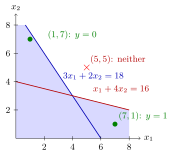
The blue region satisfies , the red region , and the allowed set is their union. The point gives but , so it is allowed with , which enforces the first inequality. The point gives but , so it needs . The point violates both and is excluded whatever is.
With the second inequality becomes , which should hold for every relevant and so restricts nothing; for the roles swap. Hence must cover the largest amount by which the switched-off left-hand side can exceed its right-hand side. If is too small, allowed points are cut away; a much larger is still correct but weakens the LP relaxation, where may be fractional.
The binary variable is needed: the union contains and but not their midpoint , since and . A system of linear inequalities always contains the average of any two of its points (see convex combinations), so none in alone describes this set. With several binaries the same device gives K-out-of-N constraints and nonconvex region modelling.
Key Results
- For , the first inequality is enforced; for , the second is enforced.
- A valid value of requires information about bounds on the expressions being relaxed.
- This is a modelling device; it does not mean multiplying two decision variables.
Examples
The blue inequality is enforced when , and the red one when . The illustrated union is nonconvex, so it cannot be represented by one system of continuous linear inequalities in alone.
- and implement the video example.
- The week 3 exercise applies the same switch to two inequalities involving four variables.
Prerequisites
Related Concepts
Sources
- OR Modelling · Week 3
Aliases: disjunctive constraints Symbols: element of
Last updated: 22 October 2026 19:04
Either-Or ConstraintsJob Sequencing ModelK-Out-of-N ConstraintsNonconvex Region ModellingBinary VariableConstraint