Project Longest Path Model
Definition
The course's project longest path model uses a directed acyclic activity network with start and finish . Each edge has an activity duration; an outgoing activity may start only after all activities entering its starting vertex finish. Under these precedence rules and without additional resource restrictions, project duration is the length of a longest -to- path.
Interpretation
The project cannot finish before its longest chain of dependent activities has finished. Activities on different chains can run side by side, but along one chain each activity must wait for the previous one, so the project duration is the length of the longest -to- path. The model finds it with binary edge-selection variables.
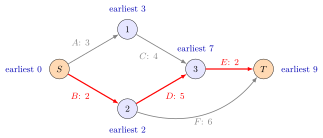
Each node carries its earliest start time: the largest total duration over the paths from to that node. Node 3 can start only when both and are done, at , and is reached at . The red path has length , but so does with : a longest path need not be unique. The path through has length , so activity could finish one time unit later without delaying the project.
The formulation reuses the shortest path binary formulation: one unit of flow leaves , enters and is balanced at every other node, but the objective is maximized instead of minimized. This is safe because a precedence network is acyclic, since a cycle would mean that an activity waits for itself; with cycles, maximizing could select an extra cycle that satisfies the balance equations without lying on the -to- path.
A common slip is to add up all activity durations. Activities on parallel chains overlap in time, so only the durations along one chain count.
Key Results
- Maximize the sum of selected activity durations.
- Use one unit of source-to-sink binary flow with balance at intermediate vertices.
- Acyclicity matters: in a general cyclic network, flow balance alone could allow unrelated selected cycles.
Examples
In the figure, both critical paths, with and with , have duration 9, compared with 8 for . Negating the activity lengths turns this acyclic longest-path calculation into a shortest-path calculation; the lack of cycles permits the negative lengths.
- In the exercise, has duration .
- has duration .
Prerequisites
Related Concepts
Sources
- OR Modelling · Week 5
Keywords: critical path method, CPM, critical path
Last updated: 20 October 2026 03:02
Project Longest Path ModelDirected NetworkShortest Path Binary FormulationPath in a NetworkAssignment Problem