Nonnegativity Constraint
Definition
A nonnegativity constraint requires a decision variable to satisfy . It excludes negative quantities while permitting zero. For a vector of variables, means for every component . In the course's augmented simplex models, all original and auxiliary variables are nonnegative.
Interpretation
A nonnegativity constraint says that a variable cannot go below zero. Produced or shipped amounts are naturally of this kind, but the model only knows it once is written down.
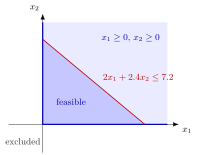
The two axes are the boundaries of and , which together keep the first quadrant. The line , meeting the axes at and , cuts off the darker triangle of feasible points; everything with a negative coordinate is excluded.
With two nonnegative variables the feasible region lies in the first quadrant. Drag the peak of the objective to the left of the -axis: the optimum moves onto the axis and the constraint binds.
Zero is allowed: corners of a feasible region often lie on an axis, such as in the Giapetto region. The constraints matter even when they look harmless: without them, maximizing over the half-plane would have no optimum, since could be made as negative as wanted. A variable that can be a profit or a loss takes either sign; it is left unrestricted or handled by a transformation. A common slip is to read as , or as " is a whole number"; it means neither.
Key Results
- Nonnegativity is a constraint, not an automatic consequence of a variable name.
- With two nonnegative variables, feasible points lie in the first quadrant.
- Nonnegative continuous variables may still take fractional values.
- At an optimum a nonnegativity constraint is either slack () or binding (); in nonlinear problems this is what the Kuhn-Tucker conditions with nonnegativity constraints handle.
Examples
- prevents negative soldier production.
- ensures that a slack variable represents unused rather than exceeded capacity.
Prerequisites
Related Concepts
Sources
- OR Modelling · Week 1
- Math IV: Multivariate Calculus · Week 7
Aliases: non-negativity constraint, sign restriction, nonnegativity restriction, sign constraint
Last updated: 26 October 2026 00:09
Nonnegativity ConstraintSlack VariableSurplus VariableUnrestricted Variable TransformationDecision VariableConstraint