Connected Network
Definition
An undirected network is connected if every pair of vertices can be joined by a path. It is disconnected if at least one pair cannot be joined.
Interpretation
A network is connected when it is in one piece: from any vertex one can reach any other along edges. The spanning-tree and undirected routing problems in the course assume this of the network.
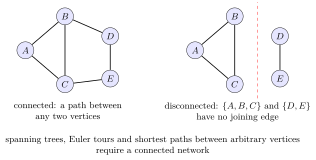
Both networks have the same five vertices. On the left every pair is joined by a path, for example or . On the right the edges stay within or within , so no path joins to ; one such pair already makes the network disconnected, although no vertex is isolated.
The condition matters whenever a route or a tree must cover the whole network: a disconnected network has no spanning tree, and vertices in different parts have no shortest path between them.
Key Results
- A disconnected network has no spanning tree covering all its vertices.
- A tree is connected as well as cycle-free.
- For a directed flow network, available directed routes must still be checked; undirected connectedness alone does not imply flow to the sink.
Examples
- A chain of roads linking A to B and B to C connects all three towns.
- Two groups of towns with no road between the groups are disconnected.
Prerequisites
Related Concepts
Sources
- OR Modelling · Week 4
Aliases: connected graph
Last updated: 20 October 2026 03:02
Connected NetworkEuler Network CharacterizationTreeUndirected NetworkPath in a NetworkMinimum Spanning Tree