Directed Network
Definition
A directed network is a network whose edges have specified orientations. An edge allows traversal or flow from to ; reverse traversal is not implied by its existence.
Interpretation
Direction represents asymmetric connections, such as one-way streets, pipes that carry flow one way, or activities that must happen in a given order. An edge says that one can go from to , and nothing about going back.
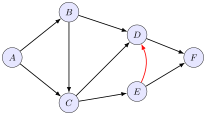
Every edge in the figure carries an arrow. The red edge allows the move from to , but no edge leads from to ; since the only edge leaving is and has no outgoing edge, cannot be reached from at all.
So every route must follow the arrows, and a two-way connection needs two opposite edges and . Direction is essential in the maximum flow problem, where each capacity belongs to one directed edge.
Key Results
- Incoming and outgoing edges have different roles at a vertex.
- Maximum-flow constraints respect the original edge directions.
- A backward residual edge cancels assigned flow; it is not necessarily an original directed edge.
Examples
The red edge permits , but there is no edge permitting . Such orientations can represent one-way streets, pipe flows or activity precedence.
- The maximum-flow network has outgoing edges at the source and incoming edges at the sink.
- An activity edge points from its preceding event to its following event.
Prerequisites
Related Concepts
Sources
- OR Modelling · Week 4
Aliases: directed graph, digraph
Last updated: 20 October 2026 03:02
Directed NetworkMaximum Flow ProblemProject Longest Path ModelNetworkResidual Network