Setup Cost
Definition
A setup cost is a fixed charge incurred whenever an order is placed, regardless of the order quantity. In the EOQ model it is denoted by . With demand rate and batch size , its average rate is
Interpretation
A setup cost is paid once per order, whatever its size, so what matters is how often orders are placed. Ordering units at demand rate gives one order every time units, the ordering cycle, hence orders per unit time and the setup cost rate .
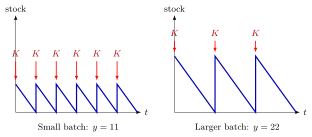
Both panels cover the same days at units per day. Batches of last days, so six setups are paid; batches of last days and need only three, but each sawtooth starts twice as high, so the average stock doubles.
Each order costs and there are orders per unit time, so setups cost . Raise to make larger batches worthwhile.
The rate falls as grows while the holding cost rate rises, and the economic order quantity balances the two. A common slip is to charge for every unit ordered: a cost proportional to the quantity belongs to the purchasing cost.
Key Results
- The charge is per order, not per inventory unit.
- A period with no order incurs no setup in the dynamic lot-size model.
- Increasing increases the classical optimal order size.
Examples
For the illustrated phone shop, per order and per day. The two panels cover the same days:
| Batch size | Number of setups | Setup cost per day |
|---|---|---|
| (left) | ||
| (right) |
Doubling the batch size halves the setup frequency and its cost rate, but doubles average stock.
- The snack bar pays 50 per order in addition to a per-kilogram purchase price.
Prerequisites
Related Concepts
Sources
- OR Modelling · Week 5
Aliases: fixed ordering cost
Last updated: 20 October 2026 03:02
Setup CostClassical EOQ ModelDynamic Lot-Size ModelInventory PolicyOrdering CycleHolding CostEconomic Order Quantity