Capacity Expansion Model
Definition
The course's capacity expansion model uses a binary purchase variable to switch additional capacity on or off. If existing capacity is 100 and a new machine supplies 50 more, the restriction is
Here are the production quantities that share this capacity, and means the additional machine is purchased.
Interpretation
A capacity expansion model lets the optimization decide whether to invest in extra capacity instead of fixing that choice in advance. One binary variable records the investment, and the capacity constraint changes with it.
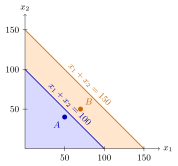
The two lines are the two possible capacity limits. With only the blue triangle below is allowed; with the orange band up to is added. The point uses units and fits either way, while uses units and is allowed only when the machine is bought.
The right-hand side is linear in , so the model stays a mixed integer program: the quantities may be continuous while is binary. The constraint allows the extra units when but does not force their use. Without a cost attached to , choosing is therefore never worse, and nothing in the model discourages buying the machine. The investment cost has to appear in the objective, for example as a term in a profit maximization with purchase cost , or in a budget constraint.
The integrality of is essential. In the LP relaxation, would be allowed and would give capacity , as if part of a machine could be bought. The same device, a right-hand side switched by a binary variable, is also used in either-or constraints.
Key Results
- With , the capacity limit is 100.
- With , the capacity limit is 150.
- Any specified acquisition cost must also be represented in the economic objective or budget; the isolated course example only demonstrates the capacity restriction.
Examples
The illustrated point uses capacity 90 and is allowed with ; uses 120 and requires .
- A plan with total production 120 requires .
- A plan with total production 90 satisfies the capacity restriction with .
Prerequisites
Related Concepts
Sources
- OR Modelling · Week 3
Symbols: element of
Last updated: 20 October 2026 03:02
Capacity Expansion ModelBinary VariableConstraintMixed Integer ProgramContingent Decisions