Minimum-Ratio Test
Definition
For a feasible canonical tableau and an entering variable with constraint-column coefficients and right-hand sides , the minimum-ratio test selects
A row attaining the minimum supplies the leaving basic variable. Zero ratios are eligible; only the denominator must be strictly positive.
Interpretation
Once the entering variable is chosen, the ratio test decides how far it may increase: as far as possible while every basic variable stays nonnegative. The test finds the first basic variable that reaches zero; a larger step would violate nonnegativity, so that variable leaves.
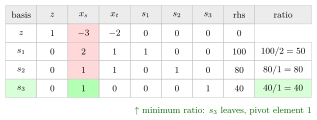
In the figure, each right-hand side is divided by the positive entry of the column. The smallest ratio, 40 in the row, is the step length: at the slack reaches zero while and are still positive. In the graph of the Giapetto model, moving from the origin along the -axis, the boundary is the first one met, at the corner .
In row the basic variable equals when the entering variable is raised to , so it reaches zero at if . Rows with are skipped because their basic variable stays the same or grows. Taking the minimum guarantees that no basic variable becomes negative. If no row has , nothing limits the increase, and an improving column then shows that the LP is unbounded.
A common slip is to compute ratios for rows with negative entries: a negative "ratio" would then win the minimum and pick a wrong leaving variable. A ratio of zero, by contrast, is eligible and gives a step of length zero.
Key Results
- Rows with zero or negative pivot-column coefficients do not restrict the increase.
- A tie may be broken arbitrarily in the course procedure and can lead to degeneracy.
- If there is no positive coefficient and the objective improves along this column, the objective is unbounded.
Examples
In the illustrated tableau, increasing gives , and . The limits give step length 40, so leaves.
- The initial ratios and make leave.
- The next ratios are and , so leaves.
Prerequisites
Related Concepts
Sources
- OR Modelling · Week 2
Aliases: minimum ratio rule, leaving variable rule Keywords: ratio test Symbols: theta
Last updated: 20 October 2026 03:02
Minimum-Ratio TestDegeneracySimplex PivotUnbounded Linear ProgramEntering Variable RuleBasic Feasible Solution