Pure Integer Program
Definition
A pure integer program is an integer linear program in which every decision variable is restricted to integer values. Nonnegativity, upper bounds, and other restrictions remain separate model constraints.
Interpretation
A pure integer program fits decisions that are counts, such as numbers of buses or workers, where a fractional answer has no meaning. Its feasible solutions are then only the points with integer coordinates inside the region of the constraints.
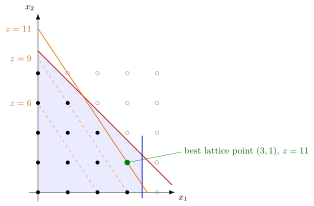
The shaded polygon is that region without integrality; the filled dots are the integer points in it. Moving the objective line outwards, the last filled dot it reaches is with , while the best point of the polygon is the corner with .
"Pure" only says that every variable is integer-restricted; nonnegativity and upper bounds remain separate constraints. The best integer point need not be a corner of the polygon, and rounding to violates , so integer programs need their own methods, such as branch-and-bound.
Key Results
- All decision variables are integer-restricted, whereas a mixed integer program restricts only some of them.
- Binary integer programs are a special case with the additional bounds 0 and 1.
- Dropping integrality gives its LP relaxation.
Examples
The figure uses the illustrative model subject to , and . Its best lattice point is with value 11; it is not a corner of the continuous polygon.
- The bus-scheduling model counts buses beginning each shift.
- The integer work-order model counts tow bars and stabilizer bars.
Prerequisites
Related Concepts
Sources
- OR Modelling · Week 2
Aliases: pure integer programming, all-integer program, pure IP Symbols: element of, integers
Last updated: 20 October 2026 03:02
Pure Integer ProgramBus Scheduling ModelInteger Linear ProgrammingBinary Integer ProgramMixed Integer Program