Binary Integer Program
Definition
A binary integer program (BIP) is a linear optimization model in which all decision variables are binary. For variables , the domain is before imposing the remaining constraints.
Interpretation
A binary integer program models a collection of yes-or-no decisions linked by linear constraints: which projects to fund, at which sites to build, which options to accept. Even a moderate number of such choices creates very many combinations.
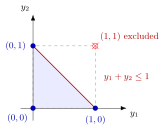
With two variables the only candidates are the four corners of the unit square. The constraint removes , so at most one of the two alternatives can be chosen, and the feasible set consists of the three dots alone. The shaded triangle contains the points that would be allowed if and could take any value between 0 and 1; its other points carry no meaning as decisions.
With variables there are assignments before the constraints are applied: , but is already more than a billion, so listing them all is not a practical solution method. Exact methods such as branch-and-bound are built to avoid this.
A binary integer program is the special case of integer linear programming in which every variable is a binary variable. Sums of binary variables count the selected alternatives, so constraints such as or express "at most " and "at least one", as in the project selection and ambulance location models.
A common slip is to allow and read the answer as a decision. The point satisfies but does not say whether either alternative is chosen.
Key Results
- There are binary assignments before functional constraints eliminate infeasible combinations.
- Its LP relaxation replaces each binary restriction by .
- The objective can count selected alternatives or weight them by costs or returns.
Examples
- Project selection maximizes the return from projects under yearly budgets.
- Ambulance location minimizes the number of selected station sites.
Prerequisites
Related Concepts
Sources
- OR Modelling · Week 2
Aliases: BIP, 0-1 integer program, binary integer programming, binary program, 0-1 program, pure binary program Symbols: element of, sum
Last updated: 20 October 2026 03:02
Binary Integer ProgramAmbulance Location ModelAssignment ProblemMinimum-Weight Perfect MatchingProject Selection ModelShortest Path Binary FormulationTask Quota AssignmentBinary VariableInteger Linear ProgrammingBranch-and-Bound