Optimization Model
Definition
An optimization model specifies decision variables , an objective function to maximize or minimize, and constraints defining the allowed decisions. Writing the feasible set as , its form is
The coefficients and other given inputs are model parameters.
Interpretation
The model states what can be chosen, what counts as better, and which choices are allowed. Solving it selects the best allowed decision according to the chosen objective.
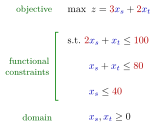
The objective function is the quantity to maximize (for example, profit) or minimize (for example, cost). Functional constraints describe what an allowed decision must satisfy, such as resource limits or demand requirements. Domain restrictions specify signs or integrality.
In the diagram, blue identifies decision variables, whose values the model determines; red identifies model parameters, the given data , and . In general, the model is subject to , where the constraints define the feasible set . A solution assigns values to all variables.
Key Results
- The objective and constraints need not be linear in a general OR model.
- Some simple models have a closed-form solution; many require an algorithm.
Examples
- For , the optimum is .
- Giapetto chooses soldier and train production to maximize profit under labour limits.
Prerequisites
- Functions and elementary algebra
Related Concepts
Sources
- OR Modelling · Week 1
Aliases: optimization problem, mathematical program, optimisation problem, optimisation model, mathematical programming problem, mathematical programming model Symbols: element of
Last updated: 17 October 2026 21:53
Optimization ModelAlgorithmDynamic ProgrammingInventory PolicyOR Study CycleRelaxationVehicle Routing ProblemGame TheoryRational AgentDecision VariableObjective FunctionConstraintLinear Programming