Minimization-to-Maximization Transformation
Proposition
Over the same feasible set, minimizing is equivalent to maximizing . The two problems have the same optimal solution vectors, and their optimal objective values have opposite signs.
Interpretation
Minimizing and maximizing are mirror images: a feasible point where is smallest is exactly a point where is largest. The simplex method is presented for maximization, and negating a minimization objective lets the same procedure be used while the constraints stay unchanged.
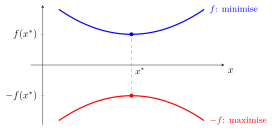
The red curve is the blue curve reflected in the horizontal axis. The lowest point of and the highest point of lie above and below the same , at heights and .
The reason is a single fact about inequalities: multiplying by reverses the direction, so holds exactly when . Only the objective is negated; the feasible set stays the same, and the optimal values satisfy .
Two slips are common: negating the constraints as well, which changes the feasible set, and forgetting to change the sign back at the end, so that the transformed value 10 is reported instead of the original minimum .
Key Results
- Negate every objective coefficient.
- Recover the original optimal value by changing the sign back.
- Only the objective changes; the allowed decisions remain the same.
Examples
- Minimizing becomes maximizing .
- In week 2 practice 8, transformed value 10 corresponds to original minimum .
Prerequisites
Related Concepts
Sources
- OR Modelling · Week 2
Last updated: 20 October 2026 03:02
Minimization-to-Maximization TransformationObjective FunctionOptimal SolutionSimplex MethodAssignment Cost Transformation