RHS Sensitivity Range
Definition
A right-hand-side sensitivity range is the interval for one constraint's right-hand side over which the current optimal basis remains feasible and optimal, with other parameters fixed. Within this range, its shadow price gives the exact linear change in optimal value.
Interpretation
In sensitivity analysis, the right-hand-side range answers how far the amount of one resource may change before its shadow price stops being valid. Inside the range the same constraints stay binding, so the same basis describes the optimum. The production quantities do change, but the optimal value changes at the constant rate of the shadow price, so a valid shadow price does not imply an unchanged solution.
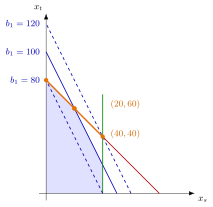
The finishing constraint is drawn for , and . As grows, the optimal corner, where the finishing and carpentry lines cross, slides along the carpentry line from to , passing at . Along the way grows from to , one unit per added hour, matching the shadow price .
Change the finishing hours : inside the shaded range the same constraints stay binding, and grows linearly in (right).
The endpoints are where the crossing point would leave the feasible region: below it would need , and above it would violate the demand limit . Beyond them another corner is optimal and the rate changes. For only trains are made and , a rate of per hour; above the optimum stays at and extra finishing hours are worth .
A common slip is to value a large change with the old shadow price. Raising from to adds hours, but rises only from to , not to .
Key Results
- Use from the report.
- A slack resource can often be reduced by its unused amount without affecting the current decision.
- A change beyond the range cannot generally be valued by multiplying the full change by the old shadow price.
Examples
For the illustrated finishing right-hand side (RHS) , the valid range is . The intersection with moves from to ; at the upper endpoint the demand limit also binds. With the illustrated objective, the shadow price is 1 per added finishing hour throughout the range.
- The metal RHS is 960, with allowable increase 240 and decrease 360; the range is 600 to 1,200.
- Milk availability can fall from 200 to 180 in the ice-cream example without changing its plan or value.
Prerequisites
Related Concepts
Sources
- OR Modelling · Week 3
Aliases: right-hand-side sensitivity range, range of feasibility, right-hand-side ranging, RHS ranging
Last updated: 20 October 2026 03:02
RHS Sensitivity RangeShadow Price in Linear ProgrammingSensitivity AnalysisObjective Coefficient RangeExcel Sensitivity Report