Interval
Definition
Let be real numbers with .
- We define the closed intervals and the open intervals as follows:
- In the case when we define the half-open intervals and as follows:
- We define open half-infinite interval as follows:
- We define closed half-infinite interval as follows:
Interpretation
Intervals are exactly the subsets of the real line without gaps: whenever two numbers lie in an interval, every number between them does too. They are the usual domains of the functions studied in this course.
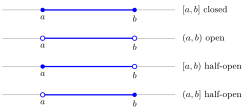
The four number lines show the intervals from to . A filled dot marks an endpoint that belongs to the interval and a hollow dot one that does not: has both endpoints, neither, and each half-open interval has one. In the notation, a square bracket corresponds to a filled dot and a round bracket to a hollow one.
Each interval is a subset of the real numbers defined by inequalities. Weak inequalities include the endpoint and strict inequalities exclude it. The symbols and are not real numbers, so they always take a round bracket: one writes , never . The half-infinite intervals, together with itself, are the unbounded intervals; the others are bounded. The case is allowed for the closed and open intervals: is a singleton and is the empty set.
Whether the endpoints belong to the interval often matters: has maximum , while has no maximum, although its supremum is still . A common slip is to read as a point of the plane. The same symbols denote an ordered pair of coordinates, and only the context tells which is meant.
Key Results
- Intervals may be open, closed, or half-open.
- Endpoints determine whether boundary values are included.
Examples
- is an open interval.
- includes both endpoints.
Prerequisites
Related Concepts
Sources
- Math I: Calculus · Lecture 4
Symbols: element of, infinity, real numbers
Last updated: 20 October 2026 03:02
IntervalConvexity and ConcavityEndpoint and Bounded IntervalPunctured NeighbourhoodUniform DistributionConvergence of Power SeriesHeine-Cantor TheoremSubsetInequalityLength of an IntervalPartition of an IntervalConnected and Disconnected SetsOpen and Closed Sets in a Metric Space