Open and Closed Sets in a Metric Space
Definition
For a metric space and its subset :
- is closed if it includes all of its boundary points, i.e., .
- is open if it doesn't include any of its boundary points, i.e., .
- is neither open nor closed if it includes some but not all of its boundary points.
Interpretation
Openness and closedness are decided by the boundary of a set. Open sets keep their boundary points out, closed sets keep them in, and sets that include some boundary points but not others are neither open nor closed.
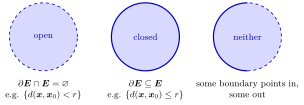
All three discs in the figure have the same boundary, the circle. A dashed rim means that the circle is excluded, as for the open disc ; a solid rim means it is included, as for the closed disc . The third disc contains half of its rim, so it fails both conditions.
The Key Results give two working descriptions. A set is open if and only if every point of it is an interior point: around each point there is a ball inside the set, so one cannot reach the outside by a small step. A set is closed if and only if it contains the limits of its convergent sequences, so one cannot leave it by passing to a limit. Since is open exactly when its complement is closed, every statement about open sets has a mirror statement about closed sets.
A common slip is to treat "open" and "closed" as opposites. The interval in is neither, while and are always both. Showing that a set is not open therefore does not show that it is closed.
Open sets are also the raw material of a topology, which keeps the open sets and forgets the distances; later, continuity and compactness are expressed through open sets as well.
Key Results
- A set is open if and only if .
- A set is closed if and only if every convergent sequence within converges to a limiting point lying in .
- A set is open if and only if its complement is closed.
Examples
- The open metric ball is open.
- is both open and closed. It has no boundary points to include or exclude.
- Under the discrete metric, every set is both open and closed. Each singleton set has a ball containing only itself.
Prerequisites
Related Concepts
- Compact Set
- Interval
- Adherent Point and Closure of a Set
- Closed Metric Ball
- Complement
- Open Metric Ball
- Topology and Topological Space
Sources
- Math III: Analysis · Lecture 5
Aliases: open set, closed set, open subset, closed subset Symbols: epsilon, infinity, intersection, partial, real numbers, subset
Last updated: 20 October 2026 03:02
Open and Closed Sets in a Metric SpaceBolzano Weierstrass TheoremCoverEquivalent Formulation of ContinuityReal Analytic FunctionTopologically Equivalent MetricsUnion and Intersection of Closed SetsUnion and Intersection of Open SetsTwice Continuous Differentiability on R^nBoundary of a SetCompact SetIntervalAdherent Point and Closure of a SetClosed Metric BallComplementOpen Metric BallTopology and Topological Space