Function between Spaces
Definition
Consider a function where is a set in an -dimensional space (e.g., ) and is a set in a -dimensional space (e.g., ). We have the following terminologies:
- it is called a univariate function (also known as single variable function, function of one variable) if ;
- it is called a bivariate function (also known as function of two variables) if ;
- it is called a multivariable function (also known as multivariate function, function of several variables) if ;
- it is called a real-valued function if its codomain is a subset of ;
- it is called a vector-valued function if .
Interpretation
A function is classified by how many numbers go in and how many come out: counts the input variables and the output components. These names describe only the shape of the inputs and outputs; they say nothing about the rule itself.
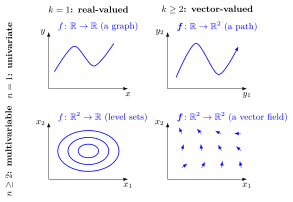
The rows of the figure separate from , and the columns separate from . Each type is drawn in its own way. A univariate real-valued function has a graph in the plane. A function is drawn as the curve traced by its outputs. A function is drawn by its level sets. A function is drawn as a vector field, with an output arrow attached at each input point. The graph of lies in , so it can be drawn directly only when .
A vector-valued function is the same as real-valued functions of the same input; it is written in bold because its values are vectors. For example, from to traces the unit circle, and each component is an ordinary function of one variable from Math I.
A common slip is to mix up the two counts. "Multivariable" refers to the inputs and "vector-valued" to the outputs: is multivariable but real-valued, and is vector-valued but univariate.
This idea returns later: the derivative of is a matrix, the Jacobian matrix, with one row per output and one column per input.
Key Results
- A multivalued function (a rule that may assign several outputs to one input, such as ) is not a function in the sense used here, so it is neither a multivariable function nor a vector-valued function.
Examples
- from to is a bivariate real valued function.
- from to is a multivariable vector valued function.
Prerequisites
Related Concepts
Sources
- Math III: Analysis · Lecture 7
Aliases: multivariable function, multivariate function, function of several variables Symbols: real numbers, square root
Last updated: 20 October 2026 03:02
Function between SpacesAffine MapHomogeneous FunctionMonomial on R^nFunctionRandom Variable