Big- and Little- Notations
Definition
Consider two functions and Let .
- We say that is big- of as tends to and write as if there is a constant such that for all near for (a punctured neighbourhood of ) when is finite, for when and for when for some or
- Assume that for all near in the same sense. We say that is little- of as tends to and write as if
The constant gives an Upper Bound on the relative size of near . For little-, use a Limit at a Point when is finite and a Limit at Infinity when to test whether tends to zero.
Interpretation
Big- and little- compare the sizes of two functions near a point while ignoring constant factors. means that near the size of is at most a constant multiple of the size of ; means that is negligible compared with near . When , this reads: goes to zero at least as fast as (big-), or faster than (little-).
The constant in big- is fixed but may be large, so big- only records an order of magnitude: and as . Little- allows no fixed constant: means that for every the bound holds for all near . Both notations depend on where goes: as , but as .
The main use is the remainder in Taylor's theorem: the error of the -th order Taylor expansion is as , small even compared with the last term kept. Comparing leading terms in this way also gives limits of quotients, alongside L'Hôpital's rule.
A common slip is to read the equals sign in as an equation. It is one-way shorthand for " is bounded by a constant multiple of near ". From and as one cannot conclude , and the reversed form is not used.
The notation returns in Life Insurance, in the force of mortality, for the probability of dying within a very short time.
Key Results
- The little- notation makes a stronger assertion than the big- notation: every function that is little- of is also big- of but not all functions that are big- of are little- of
- If and are asymptotically equivalent as tends to i.e., as then we have and as
Examples
- As , is both and since .
- As , is but not since .
-
In the following graph, we have and as :
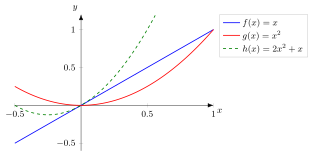
Near the parabola is much flatter than and : and as .
Zoom in towards : when some keeps near ; when the ratio (right) tends to .
Prerequisites
Related Concepts
Sources
- Math III: Analysis · Lecture 3
Aliases: Big-O, Big O, little-o, little o, Bachmann-Landau notation, Landau notation, Landau symbol Symbols: delta, element of, epsilon, infinity, real numbers
Last updated: 20 October 2026 03:02
Big-O and Little-o NotationsUpper BoundLimit at a PointLimit at InfinityAsymptotic EquivalenceTaylor's Theorem