Path Connectedness
Definition
In the metric space a nonempty subset is termed path-connected if, for any two distinct points a path exists such that and
Interpretation
You can walk from any point to any other point in a path-connected set without ever leaving the set: there is a path inside that joins them. It is a constructive way of saying that a set is in one piece.
The path must lie in for every , not only at its endpoints; a straight segment between two points of that leaves on the way does not count. Restricting the definition to distinct points loses nothing, since a constant path joins a point to itself.
To show that a set is path-connected, one writes down paths. In a set that contains the straight segment between any two of its points, such as a disc, a box or itself, the segment always works. Other sets need bent paths: the annulus is path-connected, because any two of its points can be joined by an arc of a circle followed by a radial segment.
Every path-connected set is connected, as the Key Results state, and path-connectedness is usually the easiest way to prove connectedness. In the two notions coincide, since both describe the intervals, and for open subsets of they coincide as well.
A common slip is to assume that the converse holds in general. The two Examples are connected sets with a point that no path inside the set reaches: one oscillates and the other crowds towards that point, so the set stays in one piece without being traversable.
Key Results
- In the metric space any path-connected subset of is connected.
Examples
-
The topologist's sine curve is connected but not path-connected:
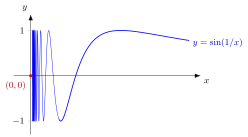
As the graph oscillates ever faster between and ; the set is connected, but no path inside it reaches .
-
The collection of line segments joining the origin to points for all positive integers , together with the point is also connected but not path-connected.
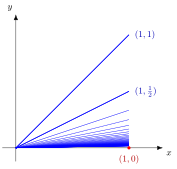
Segments from the origin to crowd towards the missing segment to ; only its endpoint belongs to the set, and no path inside the set reaches it.
Prerequisites
Related Concepts
Sources
- Math III: Analysis · Lecture 10
Aliases: path-connected, pathwise connected Symbols: element of, real numbers, union
Last updated: 20 October 2026 03:02
Path ConnectednessPath in a Metric SpaceConnected and Disconnected Sets