Weierstrass Function
Definition
The Weierstrass function is defined as
where and
Each summand uses a Trigonometric Functions cosine with increasing frequency. The Infinite Series of Functions converges uniformly (by the Weierstrass -test) because and the geometric series converges for .
Interpretation
The Weierstrass function is one of the best-known examples of a function that is continuous everywhere but differentiable nowhere. It shows that continuity, however it is pictured, does not force a graph to have a tangent at even a single point.
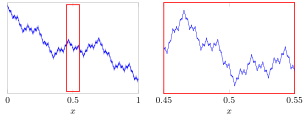
The figure plots the finite partial sum with and . The right panel magnifies the red window and illustrates the repeated roughness; the claim about the infinite limit function is stated above.
With and , add terms and zoom in: the graph keeps its wiggles at every scale, so it has no tangent anywhere.
The two conditions on and play opposite roles. The condition makes the amplitudes summable, so the Weierstrass -test gives uniform convergence, and the uniform limit of the continuous partial sums is continuous. The condition concerns slopes: the -th term has derivative , so each new term is smaller in height but steeper, and the steepness keeps increasing at ever smaller scales. The terms of the differentiated series reach size , so that series does not converge uniformly and term-by-term differentiation is not available; this explains why differentiability can fail, although the proof that it fails at every point takes more work. If instead , the derivative series converges uniformly by the -test and is differentiable.
In Weierstrass's original paper the function is with , a positive odd integer and . Riemann's series is sometimes mentioned in the same context; it is continuous by the same -test argument, but it is differentiable at some points, so it is not a nowhere differentiable function.
A common slip is to read the plotted curve as the function itself. Any plot shows a finite partial sum, which is differentiable everywhere; the roughness at every scale belongs only to the infinite sum.
Key Results
- The Weierstrass function is continuous everywhere as long as
- The Weierstrass function is nowhere differentiable if
Examples
- is a particular Weierstrass function.
Prerequisites
Related Concepts
Sources
- Math III: Analysis · Lecture 2
Symbols: infinity, pi, sum
Last updated: 20 October 2026 03:02
Weierstrass FunctionTrigonometric FunctionsInfinite Series of FunctionsWeierstrass M-test