Uniform Norm
Definition
On a nonempty set , the uniform norm of a bounded function is defined as:
Interpretation
The uniform norm measures the size of a bounded function by its worst case: the supremum of the absolute value over the whole set . Applied to a difference, is the largest vertical gap between the graphs of and , and it serves as the distance between the two functions.
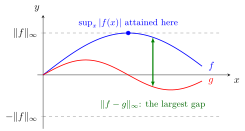
The dashed lines in the figure are at , and the dot marks where reaches its supremum. The green arrow marks where the vertical gap between and is largest; its length is . That gap is longer than itself, because is negative where is large, so the norm of a difference cannot be read off from the norms of and alone.
The red segment marks the largest gap between and : that is . Uniform convergence means it tends to .
Boundedness of makes the supremum finite. The supremum need not be attained: for on in the Examples, while everywhere. It behaves like a length on the bounded functions: only for the zero function, , and the triangle inequality holds because for every .
The norm turns uniform convergence into convergence of numbers, as in the Key Results. It also appears in normal convergence, in the Weierstrass -test and in the Weierstrass approximation theorem.
A common slip is to confuse with at every . On the functions tend to at every point, yet for every .
These three properties return later as the definition of a norm; for vectors in the same recipe gives the maximum norm.
Key Results
- For possibly unbounded functions, the same supremum of the error may be ; it is an extended error measure rather than a norm on the space of all functions. Uniform convergence means these errors eventually become finite and tend to zero.
Examples
- For the function defined by , we have
- For the function defined by , we have
Prerequisites
Related Concepts
Sources
- Math III: Analysis · Lecture 2
Aliases: sup norm, supremum norm Keywords: infinity norm, Chebyshev norm Symbols: element of, infinity, lambda, real numbers
Last updated: 20 October 2026 03:02
Uniform NormNormal ConvergenceWeierstrass Approximation TheoremWeierstrass M-testBounded FunctionSupremumEuclidean NormUniform ConvergenceMaximum Norm