Closed Metric Ball
Definition
For a metric space , a point in , and , the closed metric ball in , centred at with radius in metric , is defined as the following set:
The ball is a subset of the ambient space : its members are selected by the distance condition, not by adding new points to .
Interpretation
A closed metric ball is the set of all points whose distance from the centre is at most the radius : the open ball together with the points at distance exactly . In with it is the closed interval .
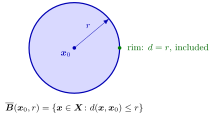
The disc is drawn with a solid rim. The green point on the rim has and is included, because the definition uses . In the Euclidean plane the rim is the boundary of the disc, and containing it is what makes the closed ball a closed set.
The closed ball also contains its sphere . Drag onto the boundary to see the difference.
Closedness holds in every metric space, by the triangle inequality. If , put ; every with has . So the complement of is open.
A common slip comes from the notation: looks like the closure of . The closure is always contained in the closed ball, and in with a -metric the two coincide, but in general they differ. With the discrete metric, is already closed, while is the whole space.
This idea returns later: closed balls in are standard examples of compact sets, on which a continuous real-valued function attains a largest and a smallest value.
Key Results
- The closed metric ball is a closed set.
- In a normed vector space, in particular in with any -metric, the closed metric ball is the closure of the open metric ball with the same centre and radius. This can fail for a metric that is merely topologically equivalent to these, such as on with radius .
- In a general metric space, the closed ball need not equal , the closure of the open ball.
Examples
- In with the usual distance, is the closed disc of radius centred at the origin. Points with are elements of this ball.
Prerequisites
Related Concepts
Sources
- Math III: Analysis · Lecture 6
Aliases: closed ball Symbols: element of, epsilon, real numbers
Last updated: 20 October 2026 03:02
Closed Metric BallMetric and Metric SpaceSubsetOpen Metric BallAdherent Point and Closure of a SetOpen and Closed Sets in a Metric Space