Limit Superior and Limit Inferior
Definition
Let be a sequence. For each consider the supremum and infimum of the terms from onward: and The limit superior and limit inferior of are defined as:
Apply the definition of a Limit of a Sequence to the tail suprema and infima . Their monotonicity ensures extended-real limits; if the original sequence has an ordinary limit, both tail limits equal it.
Interpretation
The limit superior and limit inferior describe where a sequence ends up in the long run, also when it does not converge: they are the eventual upper and lower bounds of its terms. Only the tail counts, so changing finitely many terms changes neither of them.
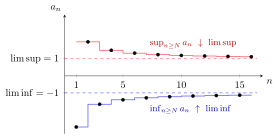
The figure shows . The tail suprema form the upper step line and decrease towards ; the tail infima form the lower one and increase towards . So and , although no term equals either value: the even terms lie above and the odd terms lie below .
Move : can only decrease and can only increase. Their limits are and .
The tail supremum is taken over fewer terms as grows, so it can only decrease, and a monotone sequence always has a limit in the extended reals. For a bounded sequence there are two equivalent readings. First, is the largest limit of a convergent subsequence, and is the smallest. Second, if , then for every the terms satisfy for all large , and for infinitely many .
These quantities appear wherever a sequence of interest need not converge. The root test uses , and the radius of convergence of a power series is .
Two slips are common. The limit superior is not the supremum of the sequence: above, , while . And it does not behave like a limit under addition: for and , , while . In general only holds, when the right-hand side is defined.
Key Results
- The limit superior and limit inferior of a real sequence always exist in the extended real numbers .
- A sequence converges if and only if its and are equal and finite; otherwise, it's divergent.
Examples
- For :
- For :
Prerequisites
Related Concepts
Sources
- Math III: Analysis · Lecture 2
Aliases: lim sup, lim inf, upper limit, lower limit, limsup, liminf Symbols: element of, epsilon, infinity, natural numbers, square root
Last updated: 20 October 2026 03:02
Limit Superior and Limit InferiorRoot TestSupremumInfimumLimit of a SequenceAccumulation Point in a Metric Space