Bounded Set in a Metric Space
Definition
Given a metric space a set is termed bounded if there exists such that the ball contains Here, can be any point in (usually chosen to be the origin or a particular point in ).
Interpretation
A bounded set is one that fits entirely inside some large enough ball, so that no two of its points are arbitrarily far apart. It extends the notion of a bounded set of real numbers to any metric space.
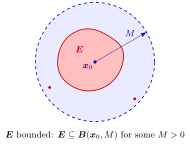
The whole set lies inside the dashed ball of radius around , so . The ball is only a witness: it need not be small or centred in , and any larger radius works as well.
The choice of centre does not matter. If and is any other point, then for every the triangle inequality gives , so ; only the radius changes. Equivalently, as in the Key Results, a nonempty set is bounded if and only if its diameter is finite.
In with the Euclidean distance, a set is bounded if and only if all coordinates of its points are bounded. Boundedness is one of the two conditions in the Heine-Borel theorem, and a bounded sequence in has a convergent subsequence by the Bolzano-Weierstrass theorem.
Boundedness depends on the metric, not only on the set. Under the discrete metric every set, including itself, is bounded, because all distances are at most . For this reason "closed and bounded" implies compact in but not in a general metric space.
Key Results
- A nonempty set is bounded if and only if is finite.
- Any subset of a bounded set is bounded.
Examples
- A unit sphere is bounded.
- A parabola curve is unbounded.
Prerequisites
Related Concepts
Sources
- Math III: Analysis · Lecture 9
Symbols: element of, real numbers, subset
Last updated: 20 October 2026 03:02
Bounded Set in a Metric SpaceBolzano Weierstrass TheoremHeine-Borel TheoremOpen Metric BallBounded Set