Root Test
Proposition
Consider the series where Let , then:
- If the series converges. Moreover, also converges.
- If the series diverges.
- If the test is inconclusive.
The -th Root measures the geometric size of each term. The Limit Superior and Limit Inferior framework uses the largest limiting tail sizes, so the test can apply even when the root sequence has no ordinary limit.
Interpretation
The root test compares a series with a geometric series directly: it compares the limit superior of the -th root of the terms' absolute values with . If eventually stays below some , then for those , and the series converges absolutely by comparison.
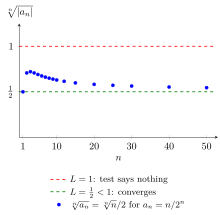
The figure shows for . The values rise from at to about at and then decrease towards , because . Since , the series converges: from on all values lie below , so there.
The th roots (right) approach ; compare with .
The limit superior is used because the root sequence need not converge. Take for even and for odd . The roots alternate between and , so and the series converges, while the ratios tend to along even and to along odd , so the ratio test gives no answer. Whenever the ratio limit exists, the root test gives the same , so the root test applies in more cases. If , then for infinitely many , the terms do not tend to , and the series diverges.
For a power series, , which gives the formula for the radius of convergence in the Key Results, also known as the Cauchy-Hadamard formula.
A common slip is to conclude convergence because every root is below . For the harmonic series, for all , but the roots tend to and the series diverges.
Key Results
- The ordinary limit used in the ratio test may not exist. The root test above uses a limit superior, which always exists in , even when the root sequence has no ordinary limit.
- The radius of convergence of a power series is given by
Examples
- is convergent since
- diverges since
- When both convergent and divergent series exist, e.g., diverges while converges.
- is convergent for since
- is divergent except at since
Prerequisites
Related Concepts
Sources
- Math III: Analysis · Lecture 2
Aliases: Cauchy's root test, nth root test Keywords: Cauchy-Hadamard theorem Symbols: element of, infinity, real numbers, square root, sum
Last updated: 20 October 2026 03:02
Root TestInfinite Seriesn-th RootLimit Superior and Limit InferiorRatio TestRadius and Interval of Convergence