Topology and Topological Space
Definition
A topology on a set , often denoted by , is a collection of subsets of that satisfies the following properties:
- Both the empty set and the entire set belong to .
- Any union of elements in also belongs to .
- The intersection of any finite number of elements in remains in .
The pair is called a topological space.
Interpretation
A topology on is a choice of which subsets count as open. It describes which points are close to which without using a distance: instead of balls of radius one works with the open sets directly, and the three axioms keep the properties that open sets of a metric space always have.
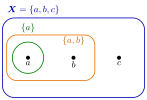
is a topology on : it contains and and is closed under unions and finite intersections, e.g. and . The members of are the open sets. The only open set containing is , so in this topology cannot be separated from or by an open set.
Arbitrary unions are allowed, but only finite intersections, because infinitely many open sets can shrink to a set that is not open: in the intersection of the open intervals is , whose boundary point belongs to it. Formally, is a subset of the power set of , not a subset of .
Every metric space gives a topology (Key Results), but not every topology comes from a metric. In a metric space every one-point set is closed, but in the figure is not closed, since its complement is not in .
This idea returns later: two metrics that give the same open sets are called topologically equivalent, and notions such as compactness are defined using open sets only.
Key Results
- Metric spaces are topological spaces. Every metric space induces a topology where open sets are unions of open metric balls.
Examples
- The trivial topology is the topology with the least possible number of open sets, namely the empty set and the entire space, i.e., .
Prerequisites
Related Concepts
Sources
- Math III: Analysis · Lecture 5
Aliases: topological space Symbols: epsilon, intersection, real numbers, tau, union
Last updated: 20 October 2026 03:02
Topology and Topological SpaceTopologically Equivalent MetricsSubsetEmpty SetUnion of SetsIntersection of SetsFinite and Infinite SetsOpen and Closed Sets in a Metric Space