Directional Derivative
Definition
Consider a subset and a function . Let be an interior point of and be a unit vector in (note: some authors only require to be a nonzero vector). If the limit
exists, then is said to be differentiable in the direction at . This limit is termed the directional derivative and is denoted by .
Here unit length is measured by the Euclidean Norm, . Equivalently, the Inner Product satisfies , so measures distance travelled along the chosen direction.
Interpretation
The directional derivative measures the instantaneous rate of change of a function as you move from a point in a specific direction.
It generalizes the one-sided derivative to functions of several variables by looking at how the function changes along a straight line in that direction.
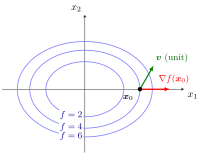
For a differentiable and a unit direction , the directional derivative is . For the nonzero gradient drawn, it is largest when the direction follows the gradient and zero in a tangent direction to the level curve.
Turn the direction with : the slope of along is , largest along the gradient and zero along the level curve.
Turn : the slice of the graph through in direction has slope .
Key Results
- If is totally differentiable at then the directional derivative exists for every direction and equals the total derivative at
- A function is totally differentiable at a point implies that this function is directionally differentiable in any direction. The converse is incorrect.
Examples
- For the function , consider and . We have .
Prerequisites
Related Concepts
Sources
- Math III: Analysis · Lecture 11
Symbols: nabla gradient, real numbers, subset, theta
Last updated: 17 October 2026 21:53
Directional DerivativePartial DerivativeSteepest Ascent DirectionInterior of a SetConvergence in a Metric SpaceVectorInner ProductEuclidean NormTotal Derivative as a Linear Map