Taxicab Metric
Definition
The taxicab distance between points and in an -dimensional real coordinate space with fixed Cartesian coordinate system is:
The taxicab norm, or known as norm, of is calculated as:
The coordinate sum defines a norm length, and subtracting two points gives a metric distance. Its triangle inequality follows by adding over the coordinates.
Interpretation
The taxicab distance represents the distance a taxi would travel between two points when restricted to cardinal directions (north, south, east, west) without moving diagonally or in any other curved path. It adds the coordinate differences instead of combining them by Pythagoras, so it is the -metric with .
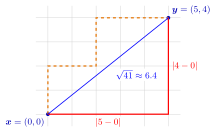
The red staircase has taxicab length . Any monotone staircase between the points has the same length, whereas the blue straight segment has Euclidean length .
In the taxicab norm the unit circle is a diamond. Drag : the -norm is always at least the Euclidean norm.
The diamond-shaped unit circle shows how the taxicab norm weighs directions: the point has taxicab norm , the same as , although it is closer to the origin in the Euclidean sense. In general on , the upper bound by the Cauchy-Schwarz inequality. In the figure, , close to equality because the two coordinate differences are almost equal. These bounds make the two metrics strongly equivalent: they give different numbers but the same convergent sequences.
A common slip is to think that the taxicab distance depends only on the geometry of the plane. It depends on the chosen axes, which is why the definition fixes a Cartesian coordinate system: the vectors and have the same Euclidean length , one being a rotation of the other, but taxicab norms and .
Key Results
- The closed unit ball in the taxicab norm is an -dimensional cross-polytope, e.g., a diamond in and a regular octahedron in .
Examples
- .
- .
Prerequisites
Related Concepts
Sources
- Math III: Analysis · Lecture 4
Aliases: Manhattan metric, taxicab distance, taxicab norm, rectilinear distance, L1 distance Keywords: Manhattan distance Symbols: real numbers, square root, sum
Last updated: 20 October 2026 03:02
Taxicab MetricReal Coordinate SpaceMetric and Metric SpaceNorm and Normed Vector SpaceEuclidean NormEuclidean Distancep-norm and p-metricMaximum Norm