Equivalent Formulation of Continuity
Theorem
Let and be metric spaces, and let be a function. The following statements are equivalent:
- is continuous.
- For every and every convergent sequence in converging to , its image under , , also converges to .
- The preimage of any open set in is open in .
- The preimage of any closed set in is closed in .
Interpretation
The theorem gives three tests for continuity that avoid and . A function is continuous if and only if it preserves limits of sequences, and if and only if the preimage operation preserves openness, or equivalently closedness.
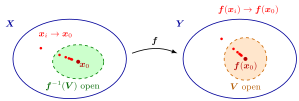
In the points approach , and in their images approach : this is the sequential condition. The dashed sets show the open-set condition. is an open set around , and its preimage , the set of all points that sends into , is an open set around . The two conditions fit together: since and is open, the eventually lie in , so the eventually lie in .
The conditions concern preimages, not images: a continuous function need not send open sets to open sets, as the Examples show. Preimages behave well because they respect complements, , which is why the open-set and closed-set versions are equivalent.
One sequence with proves discontinuity. The preimage forms prove that sets are open or closed: the open unit disc is the preimage of the open set under the continuous , so it is open, and every level set of a continuous real-valued function is closed.
The open-set form uses no distances at all. That is why it serves as the definition of continuity in a topological space, and why replacing a metric by a topologically equivalent one, which has the same open sets, does not change which functions are continuous.
Key Results
- At a fixed point the sequential condition is equivalent to continuity at In metric spaces it is often the easiest to work with when proving discontinuity. To show is not continuous at a point, find one sequence converging to that point whose image does not converge to the function value.
Examples
- A continuous function might map an open set to a non-open set . For example, let with for all . Then isn't open under usual metrics.
- A continuous function might map a closed set to a non-closed set . For example, let and for all . Then isn't closed under usual metrics.
Prerequisites
- Continuity between Metric Spaces
- Convergence in a Metric Space
- Image and Preimage of a Set
- Open and Closed Sets in a Metric Space
Related Concepts
- Uniform Continuity between Metric Spaces
- Topology and Topological Space
- Topologically Equivalent Metrics
Sources
- Math III: Analysis · Lecture 8
Aliases: equivalent definition of continuity, sequential criterion for continuity, sequential characterization of continuity Symbols: delta, element of, epsilon, infinity, real numbers
Last updated: 20 October 2026 03:02
Equivalent Formulation of ContinuityContinuity between Metric SpacesConvergence in a Metric SpaceImage and Preimage of a SetOpen and Closed Sets in a Metric SpaceUniform Continuity between Metric SpacesTopology and Topological SpaceTopologically Equivalent Metrics