Sequence
Definition
Given an integer (usually 0 or 1), a sequence is an ordered collection of elements (e.g., numbers, vectors, functions):
Interpretation
A sequence is an ordered list indexed by integers: for every index there is exactly one term , and the list never ends. Order distinguishes sequences from sets.
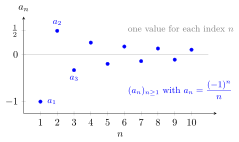
The figure plots for , with the index along the horizontal axis and the value upwards: , , , and so on. The terms alternate in sign while their distance to , , shrinks.
Two notations should be kept apart: is a single term, a number, while is the whole sequence. Passing to the set of values loses information: the sequence from the Examples has infinitely many terms, but its set of values has only two elements. What happens to for large is the subject of the limit of a sequence.
Key Results
- A sequence is a function defined on the subset of the integers.
- Order matters in sequences.
- A sequence never ends; an ordered list with only finitely many entries is a finite sequence.
Examples
- denotes an infinite sequence.
- The sequence oscillates.
Prerequisites
Related Concepts
Sources
- Math I: Calculus · Lecture 2
Symbols: infinity
Last updated: 20 October 2026 03:02
SequenceBounded SequenceCauchy SequenceFinite SequenceLimit of a SequenceConvergence in ProbabilityDifference EquationIntegerFinite SeriesInfinite SeriesFunctionSubsequenceSetStochastic Process