Stochastic Process
Definition
Let be an index set. A stochastic process is a collection of random variables defined on a common probability space, that is, one sample space with one probability function.
Interpretation
A stochastic process describes randomness that develops over time, or over another index. Instead of one random value, it is a whole family of random values , one for each index , all driven by one random experiment.
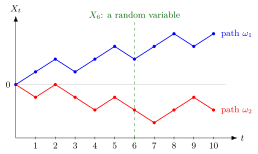
The two zigzag lines are sample paths for two outcomes and ; at each step the value moves up or down by . Fixing the outcome gives a function of time, . The vertical line at does the opposite: fixing the time gives the random variable , which takes the value on the blue path and on the red one.
Defining all on one probability space is what makes statements about several times at once meaningful, such as or the probability that a path reaches level before time . The distributions of the single do not determine such probabilities; the dependence between different times matters as well.
With the process runs in discrete time and each path is a sequence, as in the figure. With it runs in continuous time, like the count of a Poisson process, whose paths are staircases that rise by one at each arrival.
A process is not a single random variable that changes over time: each is a separate random variable, and a path is one realization of the whole family, not the process itself.
Key Results
- A stochastic process is a family of random variables indexed by time or another set.
- The index set may be discrete or continuous.
- Sample paths describe how one realization of the process evolves across the index set.
Examples
- Daily demand over a year can be modelled as a discrete-time stochastic process.
- The number of arrivals up to time in a queue is a continuous-time stochastic process.
- Stock prices observed over time form a stochastic process.
Prerequisites
Related Concepts
Sources
- Probability Theory for EOR · Week 6
Aliases: random process Keywords: collection of random variables Symbols: element of, infinity, omega
Last updated: 20 October 2026 03:02
Stochastic ProcessPoisson ProcessMarkov ChainRandom VariableArrival RateMatrixSequenceFunction