Binomial Coefficient
Definition
Let with . The binomial coefficient is the number of ways to form a combination of objects from distinct objects without regard to order, and is given by
Interpretation
The binomial coefficient , read " choose ", counts the subsets with elements of a set with elements: the number of ways to choose objects when only which objects are chosen matters, not their order.
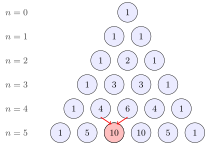
Row of Pascal's triangle lists from left to right. The highlighted entry is , and this sum has a counting reason: fix one of the five objects; a pair either contains it, and then one partner is chosen from the other four, or it does not, and then both are chosen from the other four. Each row also sums to , here , because every element is either in a subset or not, which gives subsets of all sizes together.
The formula reads as "order, then forget the order": counts the ordered selections, the -permutations, and each unordered group of objects appears among them times, so dividing by leaves the number of combinations. The symmetry is the left-right symmetry of each row.
A common slip is to stop at or at ; only the full formula counts unordered groups. Binomial coefficients are the basic tool of naive probability when the outcomes are hands, committees or samples, and they owe their name to the expansion of in the Key Results.
Key Results
- , since choosing objects is equivalent to leaving out objects.
- and .
- Binomial coefficients use factorials and appear in the expansion .
Examples
- From applicants, the number of possible interview groups of size is .
- The number of ways to choose cards from a card deck is .
- In a binomial distribution, counts the number of ways to choose which of the trials are successes, which is why it appears in .
Prerequisites
Related Concepts
Sources
- Probability Theory for EOR · Week 1
Aliases: n choose k, choose function Keywords: combination number Symbols: element of, natural numbers, sum
Last updated: 20 October 2026 03:02
Binomial CoefficientBinomial DistributionBinomial TheoremCombinationFactorialCountingStars and Bars