Support of a Random Variable
Definition
The course uses for a discrete support and a positive-density region for standard continuous models. The topological support, which depends only on the distribution, is
For the usual continuous densities, this is the closure of the positive-density region. If a density has been changed on a set of zero length, for example at finitely many points, use the neighbourhood definition: such changes do not change the support.
Interpretation
The support is the set of values a random variable can actually take, as far as probability can tell. For a discrete random variable it is the set of values with positive mass, .
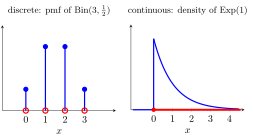
The left panel shows : the circled points form the support, the only values with positive mass. The right panel shows a continuous example, the exponential distribution with rate , whose density is to the left of and positive from on; its support is the half-line , marked in red.
The support tells where formulas apply: a mass formula such as is meant only for , and sums over the values of only need the values in the support.
The topological definition asks that every small interval around has positive probability. For a discrete variable with finitely many values this gives the same set as the positive masses; it differs only in edge cases, such as adding the endpoints and for , as in the Examples. A value outside the support is not merely unlikely: a whole interval around it has probability zero, and the CDF is constant there.
Key Results
- The course discrete support is .
- The topological support consists of points whose every open neighbourhood has positive probability, including boundary and accumulation points.
Examples
- For with , the support is .
- For , a positive-density region is , while the topological support is .
Prerequisites
Related Concepts
- Discrete Random Variable
- Continuous Random Variable
- Probability Density Function
- Uniform Distribution
- Exponential Distribution
- Survivor Function
Sources
- Probability Theory for EOR · Week 3
- Nicky van Foreest · Probability Distributions · Refresher
Aliases: support of a distribution Keywords: support Symbols: epsilon, infinity
Last updated: 22 October 2026 19:04
Support of a Random VariableRandom VariableSetDistributionDiscrete Random VariableContinuous Random VariableProbability Density FunctionUniform DistributionExponential DistributionSurvivor Function