Probability Mass Function
Definition
Let be a discrete random variable. The probability mass function of is the function defined by
It is zero except on the countable set of values that can take.
Interpretation
A PMF lists, for each possible value of a discrete random variable, the probability that the variable takes exactly that value. It describes the whole distribution of such a variable as a table or a bar chart.
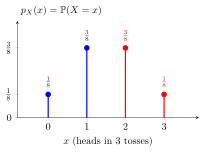
The diagram shows , the number of heads in three fair tosses, with masses , , and , which sum to . The two red bars give .
Each bar is a value of ; together they add up to . Set and to add the masses of a range of values.
Each mass is the probability of a generated event . These events are disjoint for different values and together make up the whole sample space, so the masses are nonnegative, add up to , and the probability of any set of values is the sum of the masses in ; summing up to a threshold gives the CDF, as in the Key Results.
The argument of is a value, not an outcome: in the figure, collects the three outcomes , and . The PMF is away from the possible values, for example .
Key Results
- and .
- .
Examples
- For a fair die, and .
- If and , then .
Prerequisites
Related Concepts
Sources
- Probability Theory for EOR · Week 3
- Nicky van Foreest · Probability Distributions · Refresher
Aliases: PMF, frequency function, mass function, p.m.f. Symbols: sum
Last updated: 20 October 2026 03:02
Probability Mass FunctionBernoulli DistributionExpectationFirst Success DistributionGeometric DistributionModeJoint Probability Mass FunctionExpected Payoff MaximizationExponential FamilyMaximum Likelihood EstimationDiscrete Random VariableProbability FunctionCumulative Distribution FunctionDistributionLOTUS