Standardization
Definition
Let be a random variable with mean and standard deviation . The standardization of is
Interpretation
Standardization expresses a value relative to its mean and spread. It makes variables with different units or scales easier to compare.
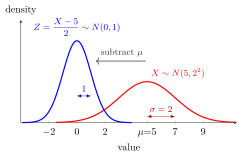
The illustrated calculation gives . Subtracting centres the distribution at and dividing by rescales the spread to , so and . The -score measures the distance from the mean in units of .
Change , and : the standardized value cuts off exactly the same probability under the standard normal.
Expectation supplies the centring value . Subtracting that value gives mean zero; dividing by the positive standard deviation then gives variance one without asserting that the transformed law is normal.
Key Results
- Standardization subtracts the mean and divides by the standard deviation.
- The standardized variable has mean zero and variance one when the original mean and variance exist.
- For normal variables, standardization produces a standard normal variable.
Examples
- A student's score can be standardized relative to the class mean and standard deviation.
- A product weight can be standardized to see how many standard deviations it lies from the target.
- Standardizing normal measurement errors allows probabilities to be computed from a standard normal table.
Prerequisites
Related Concepts
Sources
- Probability Theory for EOR · Week 5
Aliases: z-transformation, z transformation, standardisation, standardized random variable Keywords: standard score, z-score Symbols: mu, sigma
Last updated: 17 October 2026 21:53
StandardizationExpectationVariance and Standard DeviationNormal DistributionStandard Normal DistributionLocation and Scale Property of the MGF