Birthday Problem
Description
Consider a group of people and assume that each person's birthday is independently and uniformly distributed over possible days. The birthday problem asks for the probability that at least two people in the group share a birthday.
Interpretation
The birthday problem shows that coincidences can happen much sooner than intuition suggests. It is usually easier to solve by first finding the chance that no match occurs.
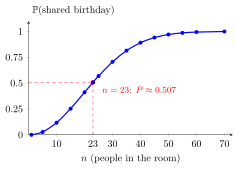
Under the model of independent birthdays uniformly distributed over 365 days, the probability of a shared birthday among people is . With 23 people there are pairs that could match, and the probability exceeds one half.
Move : the chance of no shared birthday is a product of fractions that shrinks quickly, and a match becomes more likely than not from people on.
Naive probability counts equally likely birthday assignments. The complement event has distinct birthdays, so count assignments without repetition and divide by all assignments before subtracting from one.
Key Results
- Computing the complement usually gives the simplest formula for at least one match.
- For draws from equally likely labels, the no-match probability is .
- The same calculation applies to hash collisions, repeated IDs, and sampled labels.
Examples
- In a group of people, the probability of at least one shared birthday is already above one half under the usual simplified assumptions.
- If IDs are sampled with replacement from a million possible IDs, the collision probability can be found from the no-repeat probability.
- A database using short random codes faces a birthday-type collision risk.
Prerequisites
Related Concepts
Sources
- Probability Theory for EOR · Week 1
Aliases: birthday paradox Keywords: collision probability
Last updated: 20 October 2026 03:02
Birthday ProblemNaive ProbabilityComplement of an EventIndependent EventsCountingk-PermutationSampling With and Without Replacement