Multiplication Rule for Counting
Definition
Consider a compound experiment made of two stages. If the first stage has possible outcomes and, for each of them, the second stage has possible outcomes, then the compound experiment has
possible outcomes. This is the multiplication rule for counting. For successive stages with choices it gives ordered outcomes; in set notation, .
Interpretation
The multiplication rule counts ordered outcomes stage by stage: in a tree diagram, the number of leaves is the product of the numbers of branches at each level. The same tree carries probabilities, and multiplying along a path gives the probability of that path.
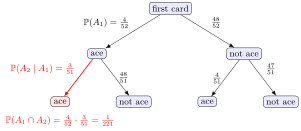
Counting the ordered outcomes gives ordered draws, of them two aces, so . Probabilities multiply along a path in the same way: .
The Cartesian product records an ordered choice from each stage. If every first-stage choice permits the same second-stage choices, counting the pairs gives .
Key Results
- The number of choices at a stage must not depend on the outcomes of earlier stages, although the choices themselves may.
- Probability version: for events and with , ; for several events the rule becomes a product of successive conditional probabilities.
- For independent events, the conditional factor reduces to the marginal probability.
Examples
- A code of two letters followed by three digits can be formed in ways.
- Two dice give ordered outcomes, and distinct objects can be ordered in ways.
- Two cards drawn without replacement are both aces with probability : the chance of the first ace times the conditional chance of the second. In counts, of the ordered draws.
Prerequisites
Related Concepts
- k-Permutation
- Conditional Probability
- Bayes Rule
- Independent Events
- Sampling With and Without Replacement
Sources
- Probability Theory for EOR · Week 1
Aliases: rule of product, fundamental counting principle, multiplication principle, basic principle of counting Keywords: product rule for counting Symbols: intersection
Last updated: 17 October 2026 21:53
Multiplication Rule for CountingSampling With and Without ReplacementCountingCartesian Productk-PermutationConditional ProbabilityBayes RuleIndependent Events