Hypergeometric Distribution
Definition
Let a population contain objects, of which are successes (), and suppose objects () are drawn without replacement. A random variable has a hypergeometric distribution if counts the number of successes in the draw, with
and for all other .
Interpretation
A hypergeometric distribution counts successes when sampling without replacement. The trials are dependent because each draw changes what remains.
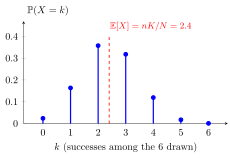
The diagram counts successes in a sample of objects drawn without replacement from objects, of which are successes. The PMF is for . Its mean is , and its variance is smaller than the variance of , the corresponding model with replacement.
Change , and : drawing without replacement gives mean , like the binomial, but a smaller variance because each draw changes what remains.
A combination counts an unordered selection without replacement. Counting the chosen successes and failures separately and dividing by all samples gives the hypergeometric probabilities.
Key Results
- The hypergeometric distribution models sampling without replacement.
- Unlike the binomial distribution, the trials are dependent.
- Its mean is when successes are in a population of size and items are drawn.
-
Its variance is
This is the binomial variance with times the finite population correction , which is below when and close to when the population is much larger than the sample.
Examples
- The number of aces in a five-card hand has a hypergeometric distribution.
- The number of defective items in a sample drawn without replacement from a shipment is hypergeometric.
- The number of red balls drawn from an urn without replacement is hypergeometric.
Prerequisites
Related Concepts
Sources
- Probability Theory for EOR · Week 3
Keywords: hypergeometric random variable, sampling without replacement
Last updated: 20 October 2026 03:02
Hypergeometric DistributionCombinationSampling With and Without ReplacementBinomial DistributionNaive Probability