Law of Total Probability
Theorem
Let be a finite or countable partition of the sample space into events. For every event ,
Null partition events contribute zero to and are omitted so that no undefined conditional probability is used.
Interpretation
Compute a probability by conditioning on each possible case and weighting by how likely that case is.
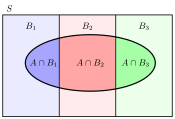
The diagram splits into the disjoint pieces , and . Their probabilities add to ; each positive-probability case contributes .
Split the sample space into three cases and set in each: is the total shaded area, a weighted average of the three.
A partition of a set divides the sample space into disjoint blocks covering every outcome. Additivity of the probability function sums the contributions from within those blocks, and conditional probabilities express each contribution as a block probability times a within-block probability.
Key Results
- for a countable partition.
- Only terms with need conditional probabilities; zero-probability cases contribute zero.
Examples
- If factories supply and of products with defect rates and , the defect probability is .
- For a fair die, conditioning on odd or even gives .
Prerequisites
Related Concepts
- Conditional Expectation Given an Event
- Continuous Law of Total Probability
- Bayes and Total Probability: Four Forms
- Law of Total Expectation over a Partition
- Fundamental Bridge
Sources
- Probability Theory for EOR · Week 2
- Nicky van Foreest · Probability Distributions · Week 3
Aliases: LOTP, total probability theorem, total probability formula, theorem of total probability, rule of total probability, law of total probabilities Symbols: intersection, sum
Last updated: 17 October 2026 21:53
Law of Total ProbabilityBayes RuleMixture DistributionTotal Probability with Extra ConditioningConditional ProbabilityPartition of a SetProbability FunctionConditional Expectation Given an EventContinuous Law of Total ProbabilityBayes and Total Probability: Four FormsLaw of Total Expectation over a PartitionFundamental Bridge