Cumulative Distribution Function
Definition
For a real-valued random variable , its cumulative distribution function is
It is nondecreasing and right-continuous, with and . These limits describe the notation and .
Interpretation
The CDF answers the question "what is the probability that is at most ?" for every threshold at once. It collects probability from the left and describes the distribution of any real-valued random variable, whether its values form a list or a whole range.
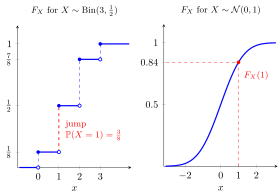
The left panel is a staircase for , the number of heads in three fair tosses. is flat between the possible values and jumps there by , reaching the levels ; each jump is the probability of that value, so . The right panel is the CDF of the standard normal distribution, which rises without any jump and has .
Move : collects all probability at or below . Masses give a staircase, a density a smooth curve, and the mixed example both a jump and a smooth rise.
Each property in the Definition has a probabilistic reason. is nondecreasing because for . The limits and hold because shrinks to the impossible event as and grows to the whole sample space as . Right-continuity holds because "" includes the threshold itself, so at a jump the value is the top of the step: in the left panel , not .
A common slip is to ignore the difference between and . In the example while ; for discrete variables the endpoints matter, hence the half-open interval in the Key Results. For a discrete random variable, is the sum of the PMF over all values .
Key Results
- .
- , where is the left limit.
Examples
- For , the CDF is for , for , and for .
- For , and .
Prerequisites
Related Concepts
- Probability Mass Function
- Probability Density Function
- Monotone Function
- Limit at Infinity
- Continuous Random Variable
- Standard Normal Distribution
Sources
- Probability Theory for EOR · Week 3
- Nicky van Foreest · Probability Distributions · Refresher
Aliases: CDF, distribution function, cumulative distribution, c.d.f. Symbols: element of, infinity, real numbers, subset
Last updated: 20 October 2026 03:02
Cumulative Distribution FunctionAbsolutely Continuous DistributionMedianOrder StatisticPoint MassQuantile FunctionUniversality of the Uniform and CDF RealizabilityConditional Cumulative Distribution FunctionConvergence in DistributionDensity of an Order StatisticJoint CDF of Continuous Random VariablesJoint CDF of Discrete Random VariablesSurvivor FunctionMedian Voter TheoremLikelihood for Grouped Loss DataMaximum Claim in a PortfolioMixed Discrete and Continuous Loss DistributionStochastic OrderRandom VariableDistributionProbability Mass FunctionProbability Density FunctionMonotone FunctionLimit at InfinityContinuous Random VariableStandard Normal Distribution