Sample Space
Definition
Let a random experiment be specified. The sample space is the set of all possible outcomes of that experiment.
Interpretation
The sample space lists everything that can happen in the model: each run of the experiment produces exactly one of its elements. Events are subsets of , so has to be fixed before any probability can be discussed.
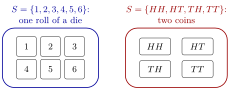
The left panel is one die roll, . The right panel is two coin tosses, , where the order of the tosses is recorded, so and are different outcomes; by the multiplication rule there are of them.
Choosing is part of modelling. For two coin tosses, (the number of heads) is also a valid sample space, but its outcomes are not equally likely, and "the first toss is heads" cannot be expressed in it. need not be finite: tossing a coin until the first head gives . Some texts write instead of .
Key Results
- The sample space must include every possible outcome in the model.
- Different modelling choices can lead to different sample spaces for the same real situation.
- Events are subsets of the sample space.
Examples
- For one coin toss, the sample space can be heads and tails.
- For two dice, the sample space can be ordered pairs of die faces.
- For a waiting-time experiment, the sample space can be all nonnegative times.
Prerequisites
Related Concepts
Sources
- Probability Theory for EOR · Week 1
Aliases: outcome space Keywords: possibility space Symbols: omega
Last updated: 20 October 2026 03:02
Sample SpaceAxioms of ProbabilityComplement of an EventEventNaive ProbabilityProbability FunctionRandom VariableSetOutcomePower SetCartesian Product