Sum of Independent Random Variables
Definition
Let and be independent random variables. The sum of independent random variables is the random variable , whose distribution is determined by combining the distributions of and .
Interpretation
The sum of independent random variables combines two separate sources of randomness, such as two dice, two service stages or two claims. Its distribution is determined by the distributions of and alone, because independence fixes how their values combine.
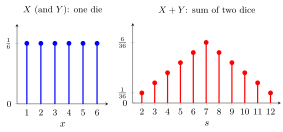
The figure compares one fair die, six bars of height , with the sum of two independent fair dice. The sum takes the values with masses rising from to and falling back to . The value is the most likely: six of the equally likely pairs give it, from to , while only gives .
Add dice one at a time: each new distribution is a convolution of the previous one with a single die. Means and variances add, and the shape becomes bell-like.
For discrete variables, the sum is found by adding over all ways to reach the total :
where independence turns the probability that and into a product. Without independence the two distributions alone do not determine the sum: for a fair die , the variable is again a fair die, yet always, while takes only even values.
Means always add, by linearity of expectation, so the sum of two dice has mean . Independence also makes variances add: one die has variance , so the sum of two independent dice has variance . A sum of independent Bernoulli variables with the same has the binomial distribution. The sum formula above later gets the name convolution.
Key Results
- The distribution of a sum of independent variables is obtained by convolution in many common settings.
- Means add whenever expectations exist.
- Variances add for independent variables with finite variances.
Examples
- The total number of heads from two independent sets of tosses is a sum of independent binomial variables.
- The total waiting time for independent service stages is a sum of waiting-time variables.
- The total claim amount from independent claims is a sum of independent losses.
Prerequisites
Related Concepts
Sources
- Probability Theory for EOR · Week 4
Aliases: addition of independent random variables, independent sum Keywords: sum of independent variables Symbols: sum
Last updated: 20 October 2026 03:02
Sum of Independent Random VariablesIndependent Random VariablesPoisson DistributionNormal DistributionExpectation