Variance and Standard Deviation
Definition
Let be a random variable with , and let . The variance of is
and the standard deviation is .
Interpretation
Variance measures how far the values of typically lie from the mean : it is the probability-weighted average of the squared distance . The standard deviation, its square root, measures the same spread in the original units of .
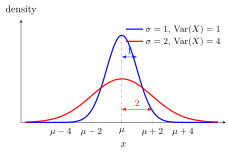
The figure shows two bell-shaped distributions with the same mean . The narrow curve has standard deviation and the wide one standard deviation ; the arrows run from to for each curve. Doubling the standard deviation multiplies the variance by four, from to , because variance is measured in squared units.
Spread the mass out and the variance grows; shift the whole distribution and it hardly changes. Darker bars contribute more to .
Each part of has a role. Centring at makes the measure ignore location: adding a constant to moves by the same amount, so . Squaring makes deviations on both sides count as positive and weights large deviations heavily. The second formula in the definition, , is usually quicker: for a Bernoulli variable , so and .
Scaling does not act linearly on variance: , while the standard deviation is multiplied by , so has the same variance as . For independent variables the variances add, as on the page on sums of independent random variables, but the standard deviations do not. Dividing by the standard deviation gives a variable with mean and variance , which returns later as standardization.
Key Results
- .
- if and only if almost surely, that is, .
Examples
- For , the variance is .
- If , then and its standard deviation is .
Prerequisites
Related Concepts
- Linearity of Expectation
- Quadratic Form
- Inner Product
- Exponentiation and Power
- Moments from the MGF
- Sum of Two IID Uniform Variables
- Jensen Inequality
- Independent Random Variables
- Moment
Sources
- Probability Theory for EOR · Week 4
- Nicky van Foreest · Probability Distributions · Refresher
Aliases: Var, SD, second central moment Keywords: variance, standard deviation Symbols: infinity, mu, sigma, square root
Last updated: 20 October 2026 19:41
Variance and Standard DeviationConditional Variance Given an EventStandardizationCauchy–Schwarz Inequality for Random VariablesCentral Limit TheoremChebyshev InequalityConditional Variance Given a Random VariableCovarianceEve’s Law: Total VarianceWeak Law of Large NumbersVariance of an Insurance Present ValueCoinsuranceExponential FamilyOptimal Bonus-Malus RelativitiesStandard Deviation Premium PrincipleVariance Premium PrincipleExpectationRandom VariableLinearity of ExpectationQuadratic FormInner ProductExponentiation and PowerMoments from the MGFSum of Two IID Uniform VariablesJensen InequalityIndependent Random VariablesMoment