Random Variable
Definition
Let be a sample space. A random variable is a function that assigns a real number to each outcome in , subject to the measurability condition that is an event for every .
Interpretation
A random variable attaches a number to every outcome of an experiment. Once outcomes are numbers, probability questions can be asked about values and ranges of values, and answered with functions and distributions.
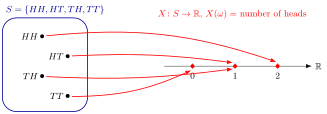
The diagram counts heads in two independent fair coin tosses: , and . Two outcomes are sent to the same value , which is allowed for a function. Each outcome has probability , so and .
The usual notation hides the outcome: is shorthand for the event . The condition in the Definition asks exactly that these sets are events, so that they have probabilities. On a finite sample space in which every subset is an event, the condition holds automatically and every function is a random variable.
Several random variables can live on the same sample space; in the coin example, the number of tails is another one. Indicators, sums and functions of a random variable build new random variables from old ones, and the CDF collects the probabilities of the events in the Definition.
Despite its name, a random variable is neither random nor an unknown: it is a fixed function. The randomness lies in which outcome occurs, and is a number once is known.
Key Results
- A random variable is a function from outcomes to real numbers.
- Random variables generate events such as threshold events.
- The distribution of a random variable describes probabilities of its numerical values or ranges.
Examples
- For a die roll, the displayed face is a random variable.
- For a customer order, the order value is a random variable.
- For a machine, the time until failure is a random variable.
Prerequisites
Related Concepts
Sources
- Probability Theory for EOR · Week 3
Aliases: stochastic variable, r.v., RV Keywords: random variate, real-valued random variable, random quantity Symbols: element of, omega, real numbers
Last updated: 20 October 2026 03:02
Random VariableContinuous Random VariableCumulative Distribution FunctionDiscrete Random VariableDistributionExpectationFunction of a Random VariableGenerated EventIndependent and Identically Distributed Random VariablesIndependent Random VariablesIndicator Random VariableOrder StatisticRandom IntervalStochastic ProcessSupport of a Random VariableVariance and Standard DeviationAlmost-Sure ConvergenceAlmost SurelyConvergence in ProbabilityMomentSample MeanTypeFunctionSample SpaceReal NumberDomainCodomainEventOutcomeFunction between Spaces