Complement of an Event
Definition
Let be an event in a sample space . The complement of , denoted , is the event
Interpretation
The complement is the event " does not happen". It contains exactly the outcomes of the sample space that are not in , so every outcome lies in exactly one of and .
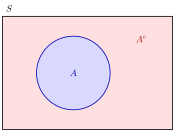
The shaded region outside the disc is . It and the disc do not overlap and together fill the rectangle , so the axioms of probability give , the rule in the Key Results.
The rule pays off for "at least one" events. In four rolls of a fair die, "no six" happens in of the equally likely ordered outcomes, so , with no case split over the number of sixes, as in the birthday problem.
A common slip is to negate the wrong word: the complement of "all four rolls show a six" is "at least one roll is not a six", not "no roll shows a six".
Key Results
- .
- and .
- The complement method is useful for events described by 'at least one'.
Examples
- The complement of 'at least one machine fails' is 'no machine fails'.
- The complement of rolling an even number on a die is rolling an odd number.
- In the birthday problem, the complement of a shared birthday is that all birthdays are different.
Prerequisites
Related Concepts
Sources
- Probability Theory for EOR · Week 1
Aliases: complementary event, event complement Keywords: complement rule Symbols: element of, intersection, omega, union
Last updated: 20 October 2026 03:02
Complement of an EventBirthday ProblemEventComplementSample SpaceAxioms of ProbabilityUnion and Intersection of EventsProbability Function