Continuous Random Variable
Definition
Under the course's absolutely continuous convention, a real-valued random variable is continuous if it has a nonnegative integrable density such that
for every interval . Necessarily . A continuous CDF by itself does not guarantee the existence of a density.
Interpretation
A continuous random variable has its probability spread over intervals rather than concentrated on single values. Probabilities are areas under its density , and every single value has probability zero.
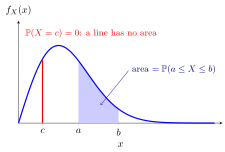
In the figure the shaded region between and has area , the integral of from to . At the point the vertical line under the curve has no width and therefore no area: , although is positive.
Two consequences follow. Endpoints do not matter, so . And is not a probability: it is probability per unit length, and it may exceed ; the uniform distribution on has density there. Where is continuous, a short interval of length starting at has probability approximately .
Compared with a discrete random variable, sums of masses become definite integrals of a density: the PMF value is a probability, while is not. The normal distribution is another standard example. Probability zero does not mean impossible: in each experiment takes some value, although every single value had probability zero.
Key Results
- for every real .
- Its CDF is absolutely continuous and equals the integral of its density.
Examples
- A uniform variable on has density there and no atom at .
- An exponential waiting time has for .
Prerequisites
Related Concepts
Sources
- Probability Theory for EOR · Week 5
- Nicky van Foreest · Probability Distributions · Week 2
Aliases: continuous r.v., absolutely continuous random variable, Continuous rv, continuously distributed random variable Symbols: element of, integral, lambda, real numbers, subset
Last updated: 20 October 2026 03:02
Continuous Random VariableExponential DistributionNormal DistributionProbability Density FunctionRayleigh DistributionTransformation of a Continuous Random VariableUniform DistributionFuture LifetimeAbsolutely Continuous DistributionRandom VariableDefinite IntegralCumulative Distribution FunctionDiscrete Random VariableSupport of a Random Variable