First Success Distribution
Definition
Let and . A discrete random variable has a first success distribution with parameter , written , if counts the trial on which the first success occurs in independent trials with success probability :
Interpretation
The first success distribution answers the question: in a sequence of independent trials with success probability , on which trial does the first success occur? The successful trial itself is counted, so takes the values .
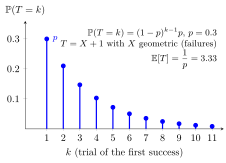
In the figure : the first bar is , and each later bar is times the previous one, , , and so on. The bars decrease from the start, so the most likely trial for the first success is always the first one, although the mean given in the figure lies further to the right.
The same shape as the geometric distribution, moved one step to the right because the successful trial is counted: .
The formula reads as a story: happens if and only if the first trials fail and trial succeeds. Each trial is a Bernoulli variable, and by independence these results have probability . In the same way , since means that the first trials all fail. The masses sum to by the geometric series , so a success eventually occurs with probability one.
Conventions differ between books and software. This page counts trials, while the geometric distribution counts the failures before the first success, so ; check which version a formula refers to, because the means differ by exactly one, against . Waiting for the -th success instead of the first leads to the negative binomial distribution, which is the first success distribution when .
Key Results
- If , then has the first success distribution.
- and .
Examples
- For , .
- For , the expected trial number of the first success is .
Prerequisites
Related Concepts
Sources
- Probability Theory for EOR · Week 3
- Probability Theory for EOR · Week 4
- Nicky van Foreest · Probability Distributions · Refresher
Aliases: first success random variable, one-based geometric distribution, FS(p), shifted geometric distribution Keywords: trial number of first success, waiting time to first success
Last updated: 20 October 2026 03:02
First Success DistributionNegative Binomial DistributionBernoulli DistributionIndependent Random VariablesProbability Mass FunctionGeometric DistributionMemoryless PropertyGeometric Series