Geometric Series
Proposition
Let be a finite geometric sequence defined by where and is known as the common ratio. The (finite) geometric series formula is given by
Taking the limit of the finite partial sums gives the infinite geometric series formula
If the series diverges when If every term is zero and the series converges for every
Interpretation
A geometric series models repeated proportional change: each term is obtained by multiplying the previous one by the fixed ratio . It is one of the few infinite series whose convergence behaviour and sum can be described explicitly, which makes it a standard benchmark for other series.
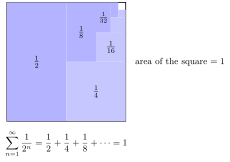
The square has area . The pieces form the geometric series with first term and ratio . After pieces the uncovered part has area , so the partial sums tend to , in agreement with .
With the partial sums settle at ; with negative they approach it from alternate sides. Push to or beyond and they stop settling.
For a finite series, subtracting times the sum from the sum cancels the intermediate terms. This gives ; the finite calculation comes before the limiting argument for an infinite series. Everything then depends on . When , and the sum is . When and , the terms do not tend to and the series diverges; for the partial sums oscillate.
A common slip concerns the first term. The formula is for a series whose first term is : , not , because its first term is . For this gives , against for the series in the Examples. Geometric sums return later, for example in the probabilities of the geometric distribution and in the ratio test of Math III.
Key Results
- If the infinite geometric series converges if and only if The all-zero series is the only exception.
Examples
Prerequisites
Related Concepts
Sources
- Math I: Calculus · Lecture 10
Aliases: geometric sum Keywords: geometric progression, common ratio Symbols: element of, infinity, real numbers, sum
Last updated: 20 October 2026 03:02
Geometric SeriesFirst-Order Linear Difference EquationAnnuity CertainInterest and DiscountingFinite SeriesInfinite SeriesArithmetic Series