Derivative and Differentiability
Definition
Let let be an interior point of that is, for some and let be a function. We say that is differentiable at with derivative and write if the two-sided limit
exists and equals the real number If the limit does not exist, we leave undefined and say that is not differentiable at At a boundary point the corresponding one-sided derivative is treated separately.
The derivative can be written using either a moving point or an increment
and the substitution shows the two forms are equivalent.
Finally, if every point of is an interior point of (for example, an open interval), is differentiable on if it is differentiable at every at the endpoints of a closed interval one uses the one-sided derivative instead.
Interpretation
The derivative measures the instantaneous rate of change of a function at a point. The difference quotient is the average rate of change between and , the slope of a secant line, and the derivative is its limit as . Differentiability means that this limit exists as a finite number.
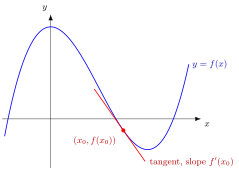
Near the marked point the curve and the tangent line are hard to tell apart, and the slope of the tangent is . Here the curve is falling at , so .
Let shrink towards from either side: the secant turns into the tangent and the difference quotient approaches . For at the two sides disagree.
Differentiability at can be read in two equivalent ways. Geometrically, the graph has a non-vertical tangent line at , with slope . Analytically, in a small neighbourhood of the function is approximated by the tangent line: with an error that is small even relative to , that is, . The second reading is the one behind the differential.
Differentiability is stronger than continuity: letting in gives . The converse fails at a corner, where the one-sided derivatives differ, and at a vertical tangent: for at the difference quotient is , which tends to .
The approximation reading returns in Math III as the total derivative of a function of several variables.
Key Results
- Differentiability implies continuity.
- The derivative is unique when it exists.
- Non-differentiability often signals sharp changes in behaviour.
Examples
- The function is differentiable everywhere.
- The function is not differentiable at
Prerequisites
Related Concepts
Sources
- Math I: Calculus · Lecture 6
Keywords: derivative, differentiable function, difference quotient Symbols: element of, infinity, real numbers, square root, subset
Last updated: 22 October 2026 19:04
Derivative and DifferentiabilityAntiderivativeChain RuleCritical PointDifferentialDifferentiation RulesFirst-Order ConditionFundamental Theorem of Calculus Part 1Higher-Order DerivativeInverse Function TheoremL'Hôpital's RuleMean Value TheoremOne-Sided DerivativeRolle’s TheoremStationary PointTransformation of a Continuous Random VariableDifferential EquationStability of an EquilibriumForce of MortalityLoimaranta EfficiencyLimit at a PointContinuityTotal Derivative as a Linear MapExponential FunctionProbability Density Function