Range and Image
Definition
If the function is the range or image of is the set
We call an output the dependent variable.
Interpretation
The range, or image, of a function is the set of outputs that actually occur. The codomain only says where outputs are allowed to lie; the range records which of these values the function really produces.
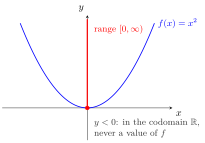
For with codomain , every output is a square, and every is reached, at : the range is the red half-line on the -axis, while negative numbers lie in the codomain but are never taken.
To decide whether lies in the range, solve for in the domain: belongs to the range if and only if there is a solution. The range equals the codomain exactly when is surjective. Some texts use the word "range" for the codomain; "image" avoids the ambiguity, and Math III writes it as , the image of the whole domain.
Key Results
- The range is a subset of the codomain.
- Different functions may share the same range.
- Determining the range often requires solving equations or inequalities.
Examples
- The range of is
- The range of is
Prerequisites
Related Concepts
Sources
- Math I: Calculus · Lecture 4
Aliases: image of a function Symbols: element of, infinity, real numbers, square root
Last updated: 20 October 2026 03:02
Range and ImageComposition of FunctionsSurjective FunctionFunctionCodomainDomainImage and Preimage of a SetBijection and Inverse FunctionRange of a Linear Map