Global Extremum
Definition
A function defined on a domain attains its global maximum (aka absolute maximum) at if for all Similarly, the function attains its global minimum (aka absolute minimum) at if for all
Interpretation
A global extremum describes the largest or smallest value a function attains over its entire domain. Unlike local extrema, which compare only with values at nearby inputs, global extrema account for all possible inputs.
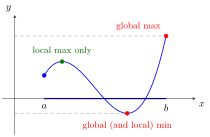
On the cubic has a local maximum inside the interval, but it is not global: the value at the endpoint is larger. The global minimum lies inside the interval, at the bottom of a valley, so it is also a local minimum. The global maximum, by contrast, sits at an endpoint, where the graph is still rising.
Move the interval : the global maximum and minimum are found among the endpoints and the stationary points inside, and a local extremum need not be global.
The definition separates the location from the value. The point need not be unique: on attains its global maximum at every integer multiple of . The value is unique when it exists, since it is the maximum of the range . It can fail to exist even for a bounded function: on has supremum but no maximum. The domain is part of the question, too: has no global maximum on , but on it has one at , with value .
For a continuous function on a closed bounded interval, the extreme value theorem guarantees that both global extrema exist. Math IV uses the same definition for functions of several variables.
Key Results
- Global extrema may occur at interior points or boundary points of the domain.
- A global extremum may not exist on unbounded or open domains.
Examples
- The function has a global minimum at
- The function has no global extremum on
Prerequisites
Related Concepts
Sources
- Math I: Calculus · Lecture 5
Symbols: element of, pi, real numbers, subset
Last updated: 20 October 2026 03:02
Global ExtremumExtreme Value TheoremGlobal Maximum and Minimum on \(\mathbb{R}^n\)FunctionMaximum of a SetMinimum of a SetLocal Extremum